Modular Construction for Speed & Reliable Execution
Integrating Modular Construction for High-Growth Strategy
Tonn and Blank partnered with Family Express as design-builder, using modular construction and prefabricated building components to deliver three nearly identical convenience store, carwash, and fueling facilities in Ligonier, Nappanee, and St. John, Indiana. Each site included a 5,795 SF convenience store and a 1,314 SF carwash (7,109 SF total), plus fuel canopies, underground fuel systems, utilities, traffic control, and roadway improvements. Together, these projects established a repeatable delivery approach that supports Family Express’s disciplined, high-growth rollout strategy where speed to market, consistency across sites, and reliable execution are non-negotiable.
The Challenge: Executing a Disciplined, Multi-Store Modular Rollout
Delivering identical convenience stores, carwashes, and fueling facilities on aggressive schedules required navigating:
- Tight speed-to-market expectations with little room for schedule drift
- Complex underground scope (utilities, fuel tanks/lines, testing, and inspections) that drives early critical path decisions
- Phased site work and building enclosure sequencing while specialty systems were being coordinated
- Coordination with owner-supplied and specialty vendors (fueling systems, carwash equipment, MEP) requiring precise handoffs
- Weather-sensitive excavation and concrete work that could disrupt traditional framing and exterior progress
- The need for repeatable quality and consistent outcomes across multiple locations (not one-off problem solving)
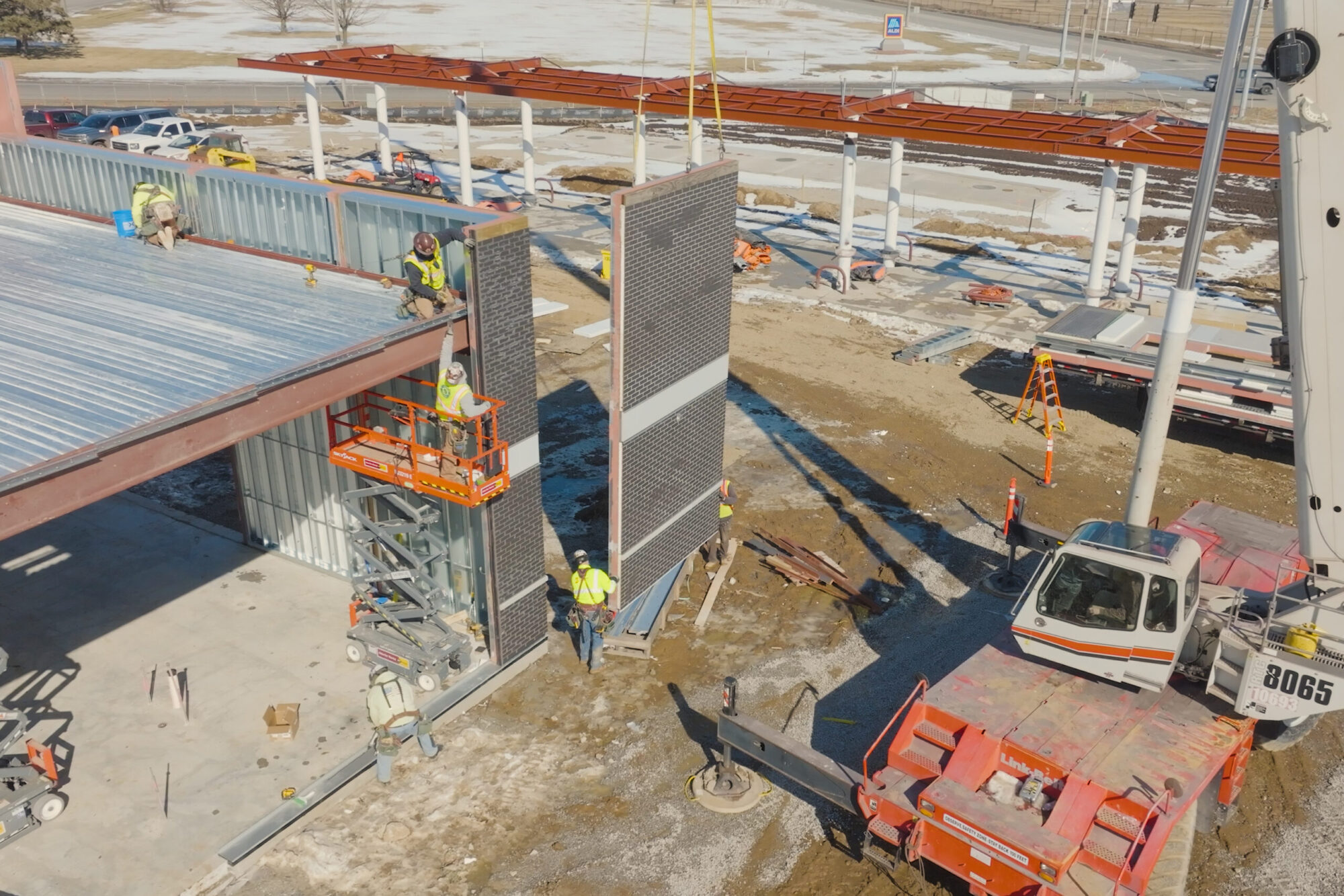
The schedule expectations were aggressive by necessity: these are revenue-generating retail sites with tightly linked opening dates, vendor lead times, and public-facing constraints. Each location carried layered complexity—utility coordination, underground fuel infrastructure, INDOT roadway work, and limited tolerance for rework once specialty systems were installed. Weather added risk to excavation, concrete placement, and exterior enclosure. As Tonn and Blank’s first convenience store, carwash, and fueling station builds, the team also had to enter a new sector without learning on the owner’s schedule or compromising jobsite discipline. Traditional construction methods alone would not have supported the required pace or predictability.
Speed to Market through Controlled Construction
The work was planned to run in parallel. While foundations, underground utilities, and site work progressed in the field, Tonn and Blank leveraged its off-site construction division to prefabricate major building components—32 wall panels for each convenience store and 16 for each carwash. This was selected as a risk-management decision as much as a schedule strategy: it reduced elevated work and scaffold time, minimized congestion and trade stacking, improved material handling, and removed weather-driven pressure that often forces inefficient or unsafe sequencing.
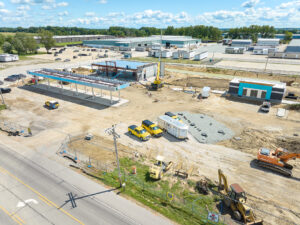
Self-performed scopes, including concrete foundations, slabs, curbs, steel erection, roofing, and wall panel installation, gave the project team direct control over critical path activities and daily work planning. Owner-supplied and specialty vendors (fueling systems, carwash equipment, mechanical and electrical trades) were integrated early through design-build coordination, pre-task planning, and clear handoff points, so the work arrived on site in the right order and could be installed without field improvisation.
A defining moment came when power availability from NIPSCO lagged behind planned milestones during underground utility and fuel system coordination. Rather than compressing activities into unsafe overlap, the team deliberately re-sequenced: prioritizing interior work tied to prefabricated panel installation and advancing non-energized systems while maintaining clean separation between crews. Temporary logistics plans and daily coordination meetings kept production moving without creating avoidable exposure or forcing last-minute rework.
Check out the exterior wall panel installation video below:
Key Takeaways
Across three fast-paced projects, the modular construction approach improved predictability and consistency from site to site, supported reliable schedule execution, and strengthened quality control by reducing field modifications. Just as important, it embedded safety into the way the work was sequenced (reducing fall exposure, congestion, and weather-related risk) while maintaining alignment with Family Express’s vendors and opening-date expectations.
These projects demonstrated a practical rollout model: plan early, build in parallel, control the critical path, and coordinate specialty partners with disciplined handoffs. For Family Express, that translated into repeatable delivery across locations, fewer surprises during installation, and confidence that future sites can be executed with the same level of speed, consistency, and operational reliability.